Indian Scientists Identify Martian Analogue Sites
Eduteria Insights · 17 Oct 2026
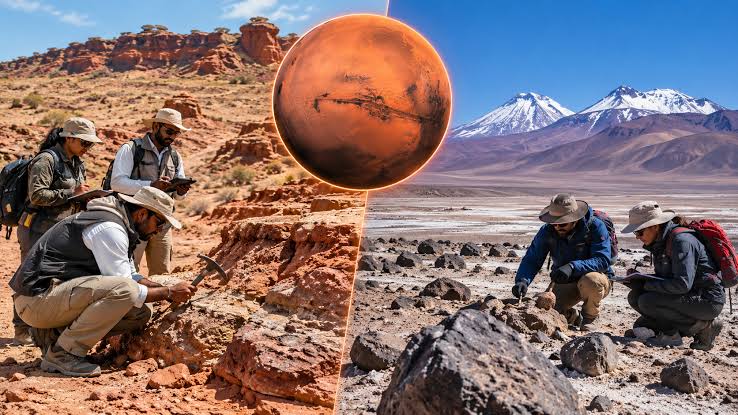
Indian scientists from University of Keralam have identified Martian analogue sites on Earth, locations whose geological features and environmental conditions resemble those found on Mars. The findings highlight sites in Tamil Nadu, India, and the Atacama Desert in Chile.
These sites can help scientists understand the Martian surface, identify minerals, test scientific instruments and prepare for future Mars missions. The central idea is that before studying Mars directly, scientists study places on Earth that behave like Mars in important ways. These findings were supported by advanced analytical equipment, including a laser Raman spectrometer, with instrumentation support from the DST-FIST programme at the Department of Geology, University of Kerala. A terrestrial analogue site is a place on Earth that resembles another planet or moon in one or more scientific characteristics. For example, scientists may study a dry desert on Earth to understand how minerals form in a dry environment on Mars. Some important minerals identified are Melanterite and Gypsum.
Note: Melanterite is hydrated iron sulphate mineral. It is identified at Nayveli, Tamil Nadu.
Swipe up (or press ↓) for the next news